Body landmarks, tape positions and measuring directions. Twenty-one schematic plates, redrawn for clarity.
Unless otherwise specified, stand upright and relaxed, barefoot, with weight even and feet about 15 cm (6 in) apart. Measure over typical undergarments, during relaxed breathing and on the same side of the body. For infants, lie flat with legs extended and feet at 90 degrees to the legs. Record lengths to the nearest 1 mm (1/16 in), weight to 0.2 kg (1/2 lb), and angles to 1 degree.
Draft for ASTM D5219-25 review. Not a measurement standard.
For the calculator's four measuring positions, use the measurement guide. Its high-hip convention differs from the level shown in the body measurements plate.
Body outline
Measurement path
Reference guide
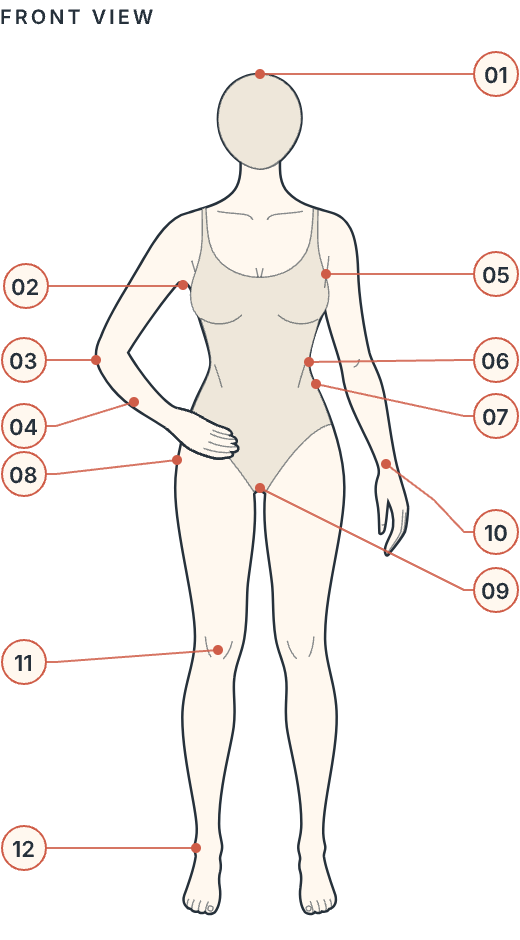
Plate 01
Body landmarks
Front view
01
Crown
The top of the head.
02
Armpit
The hollow beneath the junction of the arm and torso.
03
Elbow
The joint between the upper arm and forearm.
04
Forearm
The part of the arm between the elbow and wrist.
05
Front break-point
The point on the front of the torso where the arm separates from it.
06
Waist
At the side between lowest rib and top of pelvis; locate by bending the torso sideways.
07
Preferred waist
The level where the wearer prefers the top of lower-body garments, as specified in the size table.
08
Hip
The lateral projecting region formed by the pelvis, upper femur and surrounding flesh.
09
Crotch
The lowest point of the torso where the legs separate.
10
Wrist
The joint between the lower arm and hand.
11
Knee
The joint between the lower and upper leg.
12
Ankle
The joint between the foot and lower leg.
Reference points used throughout this measurement atlas.
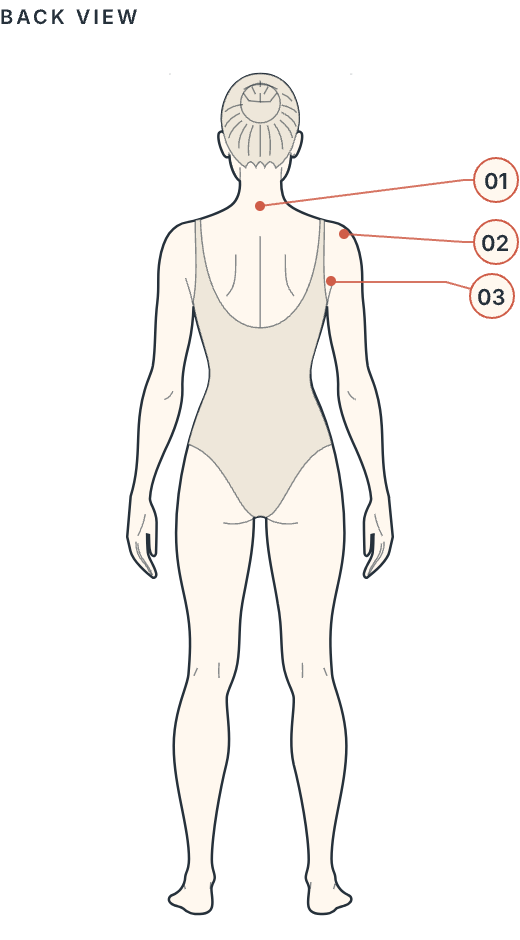
Plate 02
Upper-back landmarks
Back view
01
Cervicale
Prominent seventh neck vertebra. Locate with the head bent forward; take height with the head erect.
02
Acromion / shoulder joint
The acromion is the end of the shoulder blade; the shoulder joint is where the collarbone and shoulder blade meet.
03
Back break point
Point on the back where the arm separates from the torso.
Landmarks used to locate upper-back and shoulder measurements.
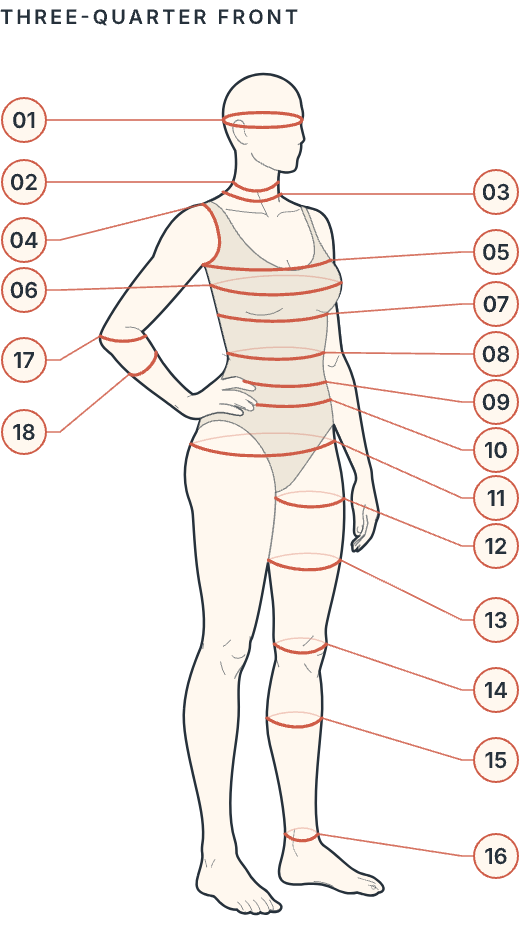
Plate 03
Body measurements
Three-quarter front
01
Head girth
Maximum horizontal circumference above the ears.
02
Mid-neck girth
Horizontal circumference about 25 mm (1 in) above the neck-base girth.
03
Neck-base girth
Around the neck over the cervicale at the back and the collarbone tops at the front.
04
Armscye girth
From the shoulder joint through front break-point, armpit and back break-point to the start; arms down.
05
Upper-chest girth
Around the torso under the arms and above the fullest chest/bust, including lower shoulder blades.
06
Chest/bust girth
Horizontally around the torso under the arms, over the bust points and lower shoulder blades.
07
Under-bust girth
Horizontal circumference around the torso under the arms and bust.
08
Waist girth
Horizontal circumference around the torso at waist level.
09
Preferred-waist girth
Horizontal circumference around the torso at preferred-waist level.
10
High-hip girth
Maximum horizontal circumference at high-hip level. If unspecified, use midway between waist and hip/seat levels.
11
Hip/seat girth
Horizontal circumference around the torso at hip/seat level.
12
Thigh girth
Maximum horizontal circumference of the upper leg, typically near the crotch.
13
Mid-thigh girth
Horizontal circumference midway between hip/seat level and the back-knee midpoint or crease.
14
Knee girth
Horizontal circumference over the kneecap, with the leg straight.
15
Calf girth
Maximum horizontal circumference between knee and ankle.
16
Ankle girth
Horizontal circumference over the greatest prominence of the ankle bones.
17
Elbow girth
Around the elbow over the outer elbow-bone prominence; arm bent, hand on hip.
18
Forearm girth
Maximum circumference between the elbow and wrist.
Eighteen body-girth locations shown in ASTM D5219-25 Fig. 3. Numbers match the list alongside.
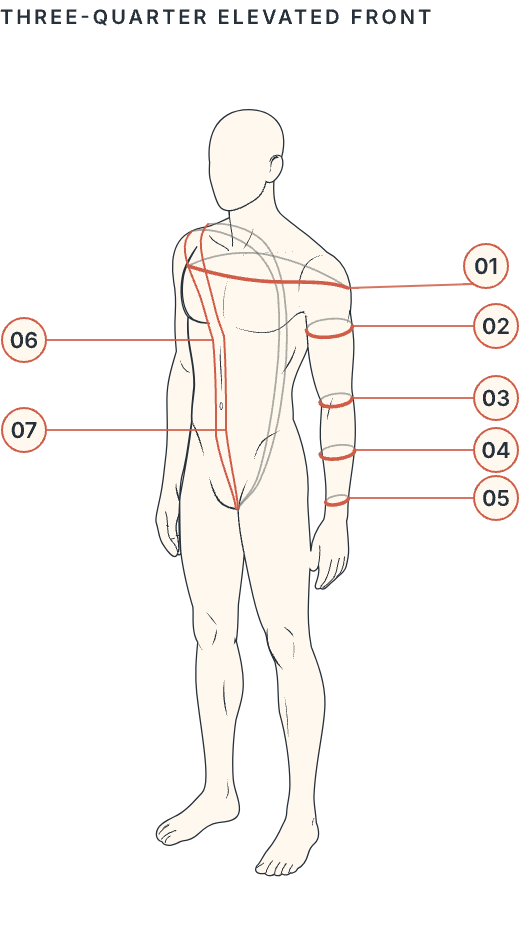
Plate 04
Upper-body girths
Three-quarter elevated front
01
Shoulder girth
Around the shoulders, midway between shoulder-point and front-break levels; arms down.
02
Upper-arm girth
Maximum circumference between shoulder and elbow; arm down.
03
Elbow girth straight
Fig. 4 shows the elbow with the arm straight. Section 3.5 defines elbow girth with the arm bent and hand on hip.
04
Forearm girth
Maximum circumference between elbow and wrist.
05
Wrist girth
Around the wrist over the inner and outer wrist-bone prominences.
06
Trunk girth (total vertical)
From the right shoulder midway between neck base and shoulder point, down the back, through the crotch and over the right bust apex to the start; avoid constriction.
07
Trunk girth at neck base
From the right shoulder at the neck-base line, down the front, through the crotch and up the back to the start; avoid constriction.
Coral marks the visible front runs; the rear portions follow the body surface and are hidden from this view.
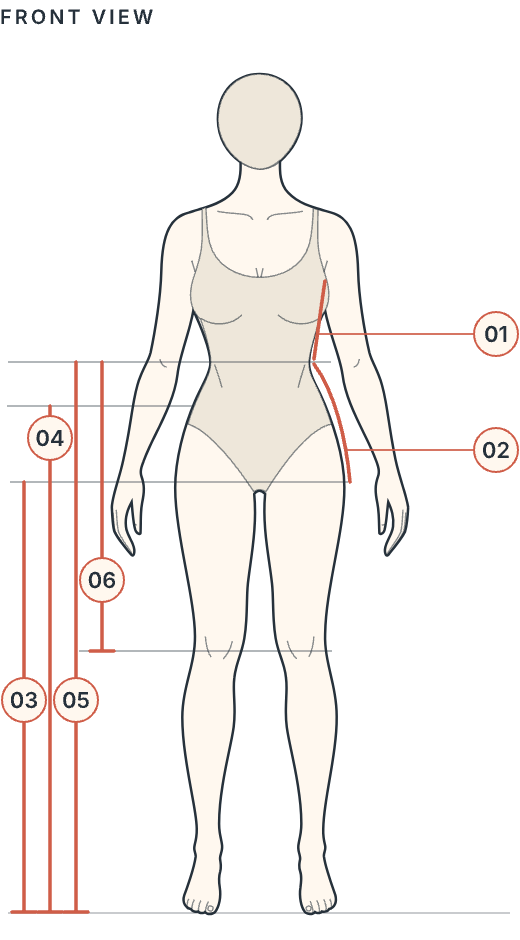
Plate 05
Contour lengths
Front view
01
Side waist length
Along the side contour from the mid-underarm point to waist level.
02
Waist to hip/seat length
Follow the side contour from waist level to hip/seat level.
03
Hip/seat length
From hip/seat level along the contour to the greatest lateral protrusion, then vertically to the floor.
04
High-hip length
From high-hip level along the contour to the greatest lateral protrusion, then vertically to the floor.
05
Waist length
From waist level via the hip/seat and greatest lateral protrusion, then vertically to the floor.
06
Waist to knee length
From waist via hip/seat and greatest lateral protrusion, then vertically to the level of the back-knee midpoint or crease.
ASTM D5219-25 Fig. 5: side waist runs from the mid-underarm to the waist; waist-to-hip/seat follows the side contour. Waist, high-hip and hip/seat lengths contour to the greatest lateral protrusion, then drop to the floor; waist-to-knee stops at the knee.
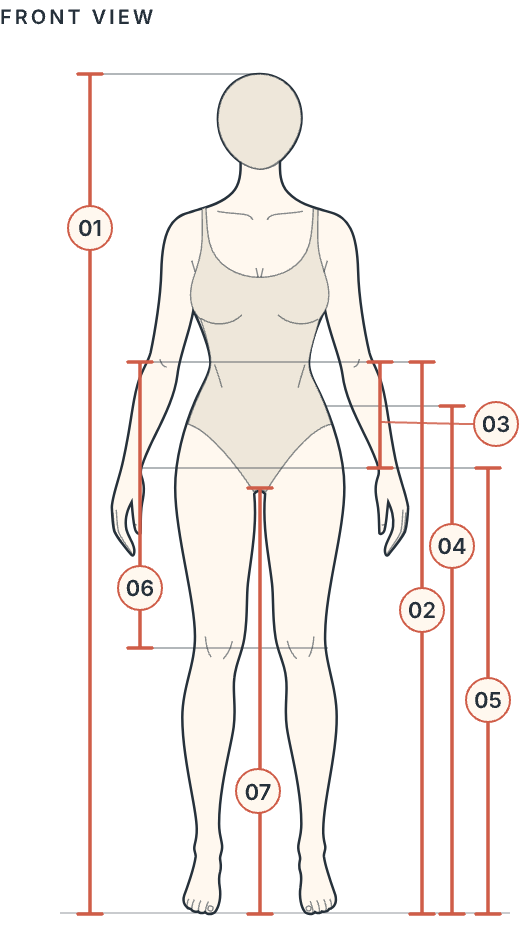
Plate 06
Vertical measurements
Front view
01
Height
Vertical distance from the crown of the head to the floor.
02
Waist height
Vertical distance from waist level to the floor.
03
Waist to hip/seat height
Vertical straight distance from waist level to hip/seat level.
04
High-hip height
Vertical distance from high-hip level to the floor.
05
Hip/seat height
Floor to hip/seat level, inferred from Fig. 6 and the general height definition; no adult-specific entry in section 3.5.
06
Waist to knee height
Vertical distance from waist level to the level of the back-knee midpoint or crease.
07
Crotch height
Vertical distance from crotch level to the floor.
On a standing subject, vertical measurements are read to the floor from the crown, waist, high-hip, hip/seat and crotch levels; waist-to-hip/seat and waist-to-knee are named separately.
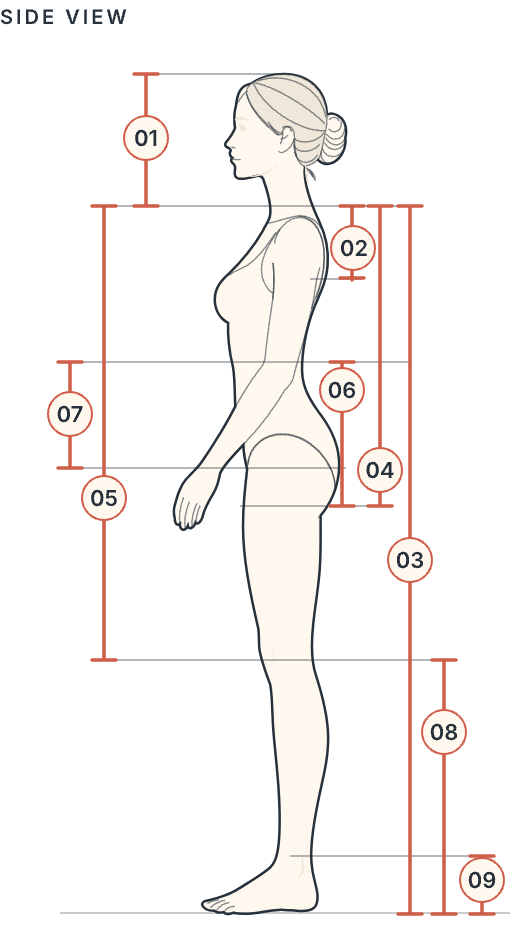
Plate 07
Vertical measurements, side view
Side view
01
Head and neck height
From crown level to cervicale level; head erect and neck unbent.
02
Scye depth
Vertical distance from cervicale level to back break-point level; arms down.
03
Cervicale height
Vertical distance from the cervicale to the floor.
04
Cervicale to crotch height
Vertical distance from cervicale level to crotch level.
05
Cervicale to knee height
Vertical distance from cervicale to the level of the back-knee midpoint or crease.
06
Rise height
Standing: vertical distance from waist level to crotch level.
07
Waist to hip/seat height
Vertical straight distance from waist level to hip/seat level.
08
Knee height
Vertical distance from the level of the back-knee midpoint or crease to the floor.
09
Ankle height
Vertical distance from the outer ankle-bone prominence to the floor.
Vertical distances use named landmark levels with the arms down and relaxed. Scye depth runs from the cervicale plane to the back break point plane.
Plate 08
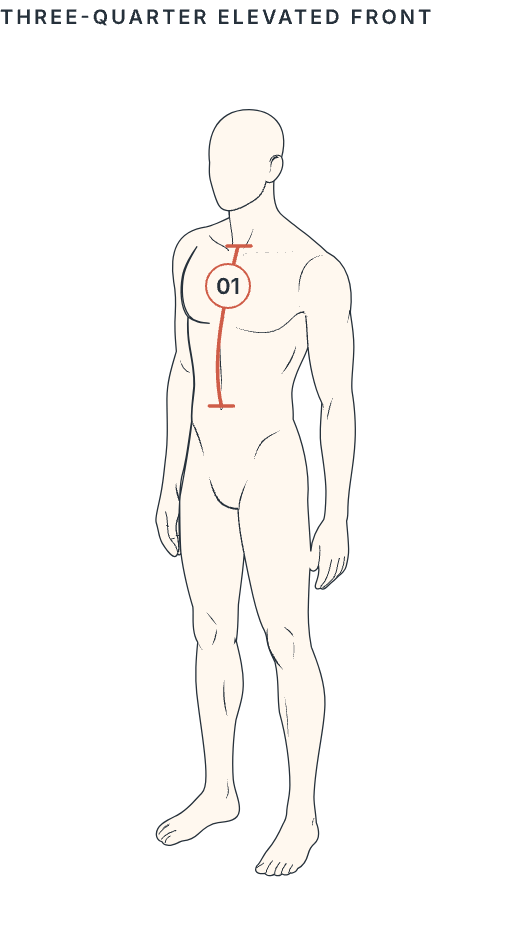
Centre front waist length
Three-quarter elevated front
01
Centre front waist length
Follow the front contour from the centre-front neck-base girth line to centre-front waist level.
Along the centre-front contour from the centre-front neck-base girth line to the waist level.
Plate 09
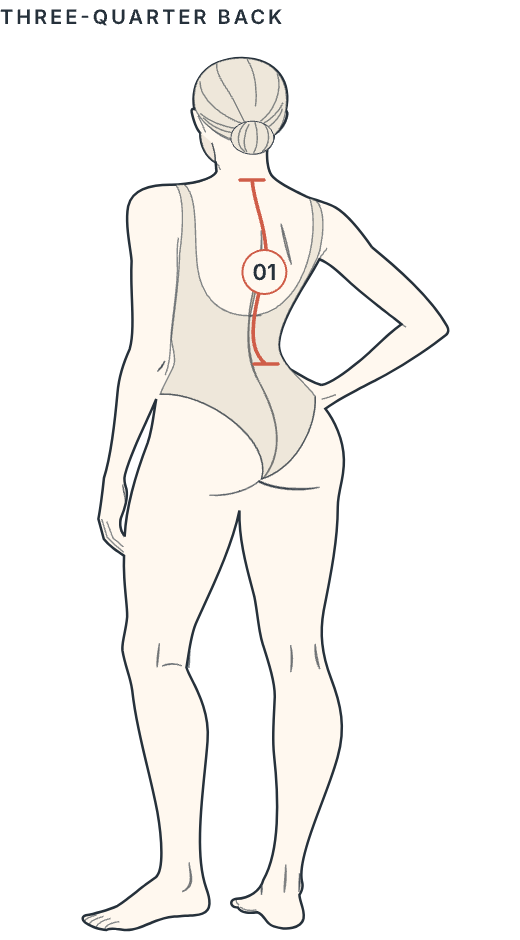
Centre back waist length
Three-quarter back
01
Centre back waist length
Follow the spine from the cervicale to centre-back waist level.
Along the centre-back contour and spine from the cervicale to the centre-back waist level.
Plate 10
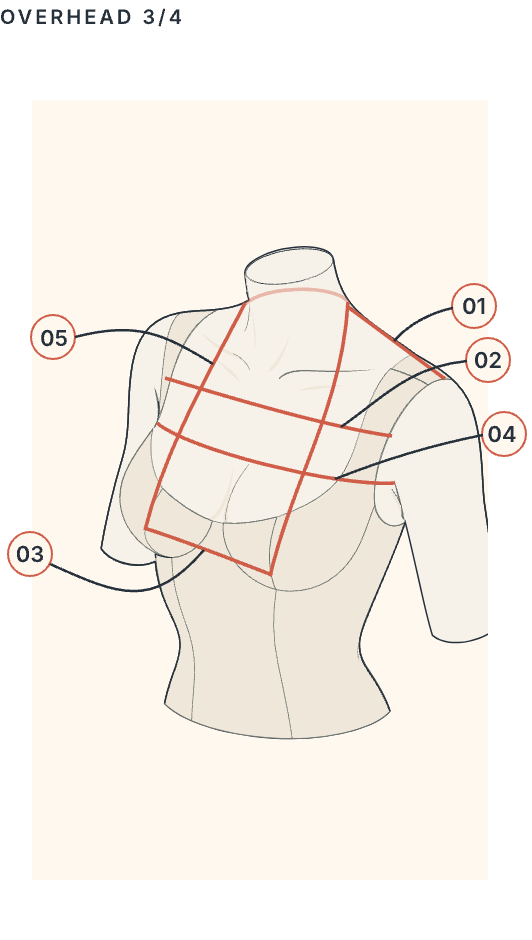
Upper-body measurements
Overhead 3/4
01
Shoulder length
From the side of the neck-base girth to the shoulder point; arm down.
02
Upper-front chest width
Across the front contour halfway between shoulder-point and front break-point levels; arms down.
03
Chest/bust point to point
Horizontal distance between the chest/bust apex points; arms down.
04
Front chest width
Across the chest contour from one front break-point to the other; arms down.
05
Chest/bust point to point (halter)
From one chest/bust apex around the back of the neck to the other apex; arms down.
Arms down. Chest widths are measured at their named levels; the halter span passes around the back of the neck.
Plate 11
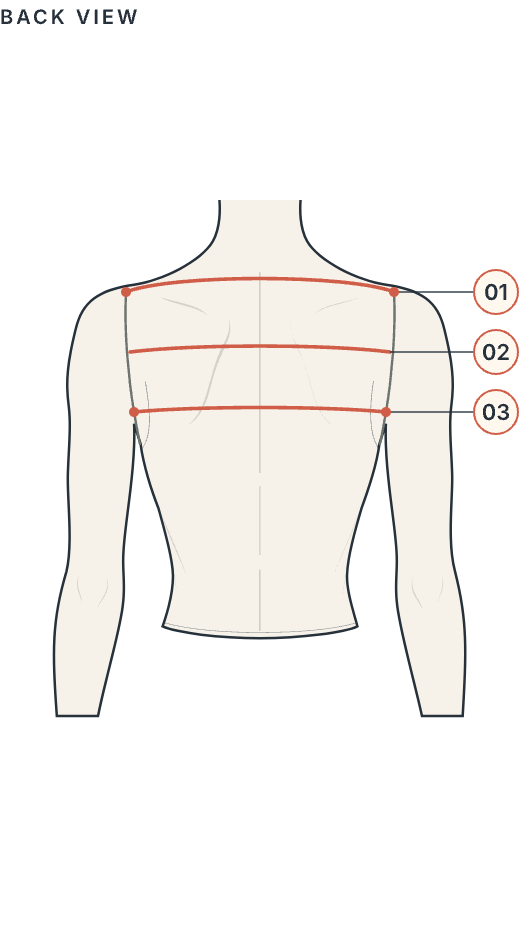
Upper-back widths
Back view
01
Across back shoulder width
Across the back contour from shoulder point to shoulder point; arms down.
02
Upper-back width
Across the back contour midway between shoulder-point and back break-point levels; arms down.
03
Back width
Across the back contour over the shoulder blades, from one back break-point to the other; arms down.
Arms down. 01 joins the shoulder points; 02 is midway between their level and the back break points; 03 joins the back break points.
Plate 12
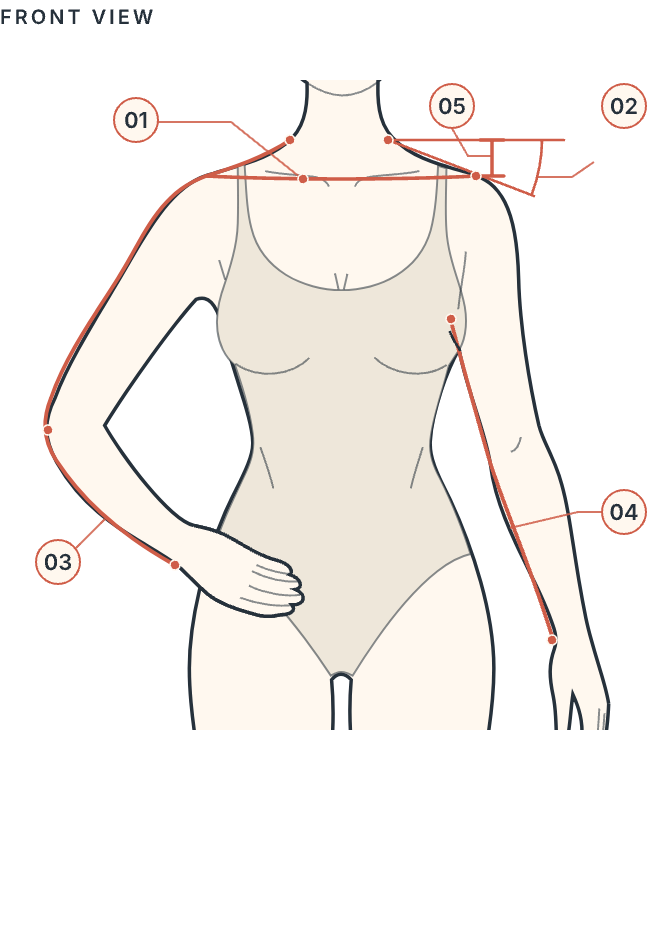
Shoulder line and arm
Front view
01
Across front shoulder width
Across the front contour from shoulder point to shoulder point; both arms down.
02
Shoulder slope
Angle between the shoulder slant and a horizontal line from the side neck base.
03
Shoulder and arm length
From side neck base over the shoulder and along the outside of the arm, over the elbow to the prominent wrist bone; arm bent, hand on hip.
04
Underarm length
Along the contour from mid-underarm point to inner wrist bone; arm down.
05
Shoulder drop
Vertical distance from side neck-base level to shoulder-point level.
Shoulder width: both arms down. Shoulder-and-arm length: elbow bent, hand on hip. The underarm start marks the front-view projection of the mid-underarm point.
Plate 13
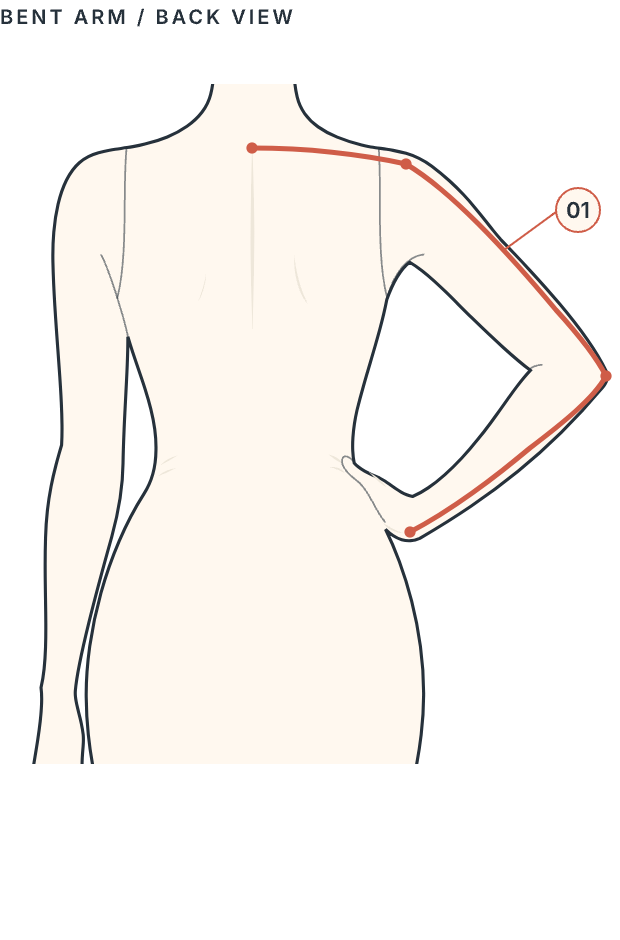
Cervicale to wrist length
Bent arm / back view
01
Cervicale to wrist length
From the cervicale over the shoulder point and along the outside of the arm, over the elbow to the prominent wrist bone; arm bent, hand on hip.
With the elbow bent and the hand on the hip, measure from the cervicale (prominent seventh neck vertebra), over the shoulder point and along the outside of the arm, across the elbow to the prominent wrist bone.
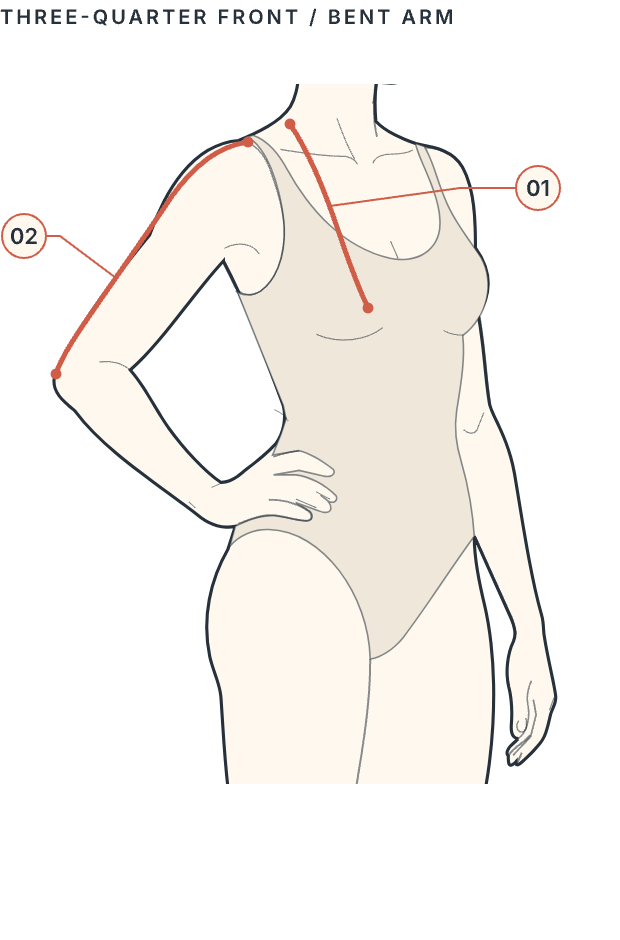
Plate 14
Neck point and arm
Three-quarter front / bent arm
01
Neck to chest/bust point length
Follow the contour from the side of the neck base to the chest/bust apex; arms down.
02
Shoulder to elbow length
From shoulder point along the outside of the arm to the prominent elbow; arm bent, hand on hip.
01: With the arms down, follow the body contour from the side of the neck base to the chest/bust point. 02: With the arm bent and hand on the hip as illustrated, follow the outside of the arm from the shoulder point to the prominent point of the elbow.
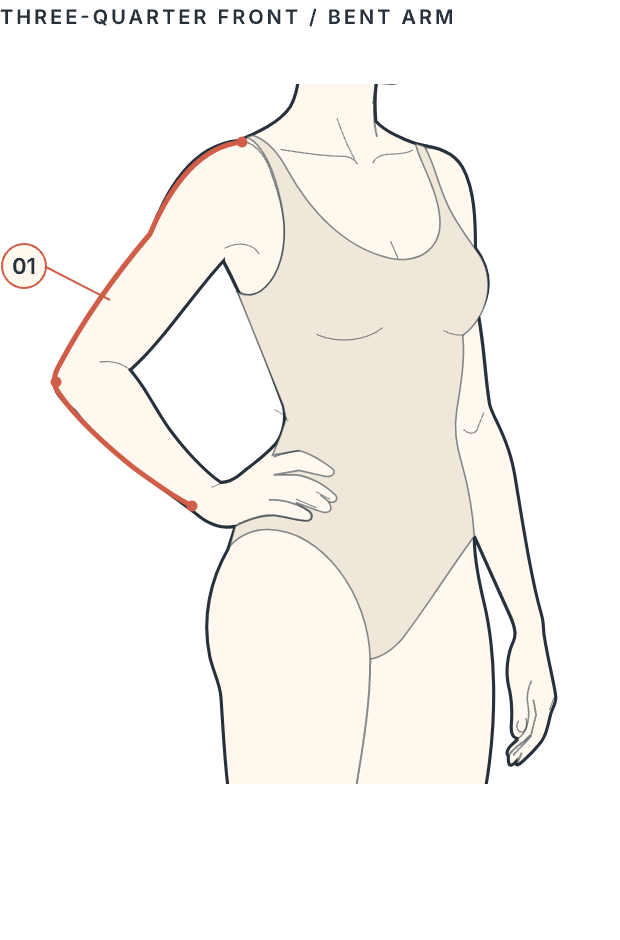
Plate 15
Arm length, bent arm
Three-quarter front / bent arm
01
Arm length (bent arm)
From shoulder point along the outside of the arm, over the elbow to the prominent wrist bone; arm bent, hand on hip.
With the elbow bent and the hand resting on the hip, measure from the shoulder point along the outside of the arm, over the elbow to the prominent wrist bone.
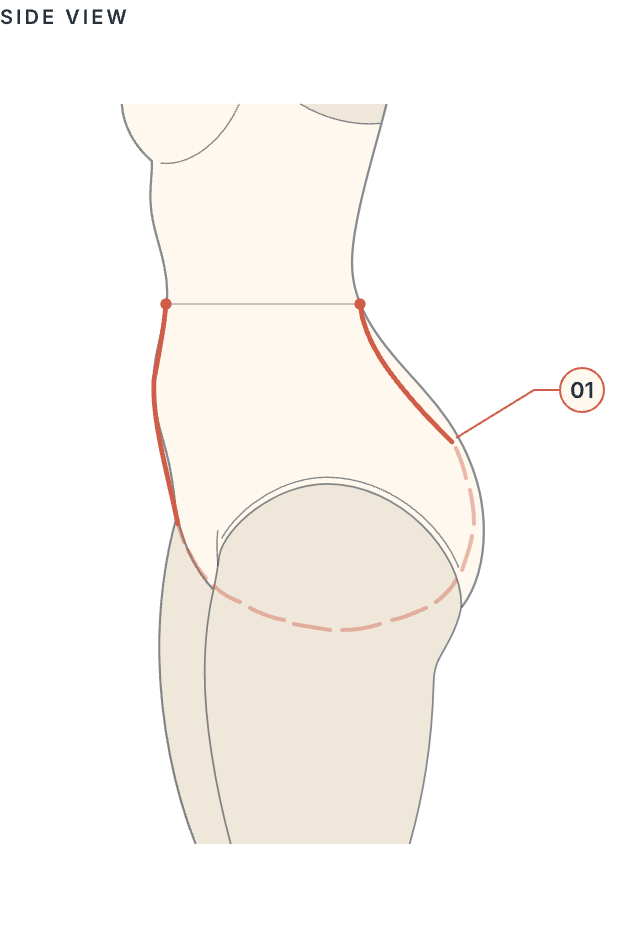
Plate 16
Crotch length, total
Side view
01
Crotch length (total)
From centre-front waist level through the crotch to centre-back waist level; avoid constriction at the crotch.
Measure from the centre-front waist level, through the crotch, to the centre-back waist level. Avoid constriction at the crotch.
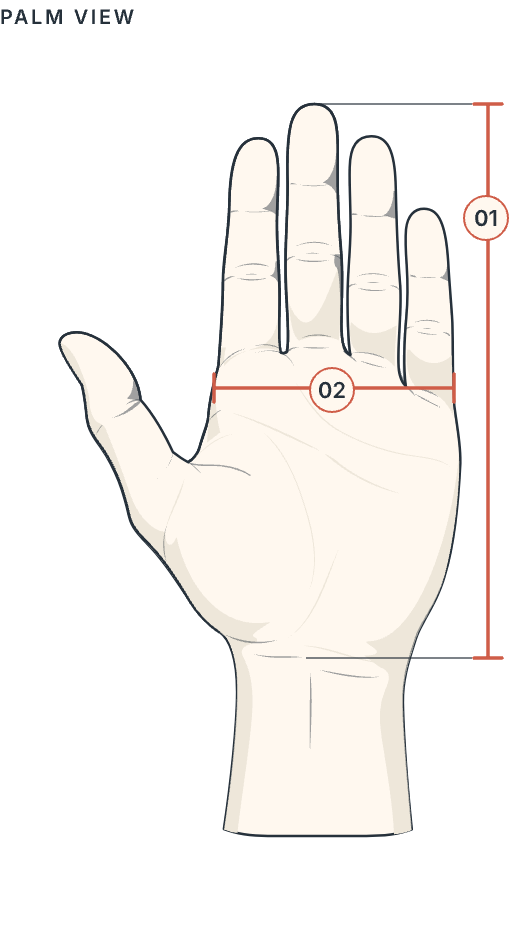
Plate 17
Hand width and hand length
Palm view
01
Hand length
Straight across the palm from the longest fingertip to the inner wrist bone; fingers together, palm flat. Use a stable, flat ruler.
02
Hand width
Maximum straight distance across the palm, excluding the thumb; fingers together, palm flat. Use a stable, flat ruler.
Both are straight measurements with fingers together and palm flat; use a stable, flat ruler. Hand length ends at the inner wrist bone; hand width excludes the thumb.
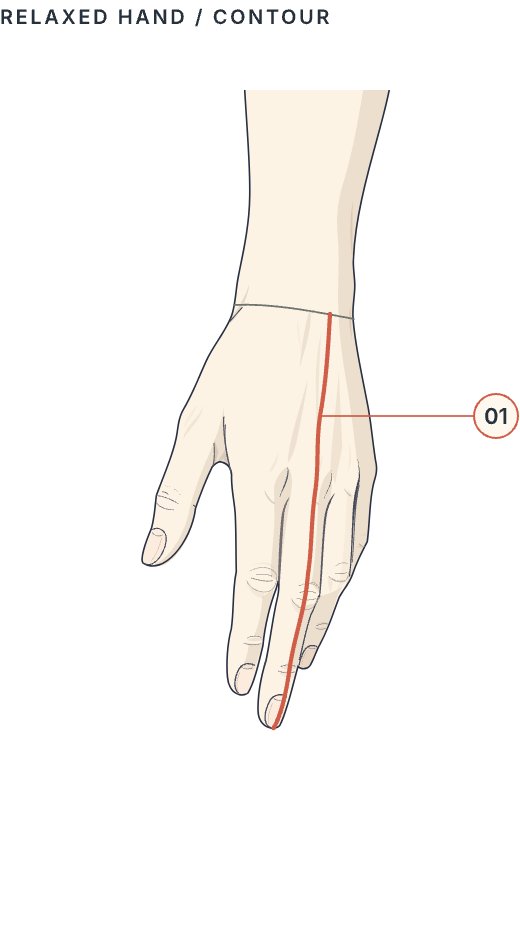
Plate 18
Hand length, contour
Relaxed hand / contour
01
Hand length (contour)
Standing with the arm and hand relaxed, follow the hand contour from the longest fingertip to wrist-girth level.
Standing with the arm and hand relaxed, follow the hand contour from the longest fingertip to the wrist-girth level.
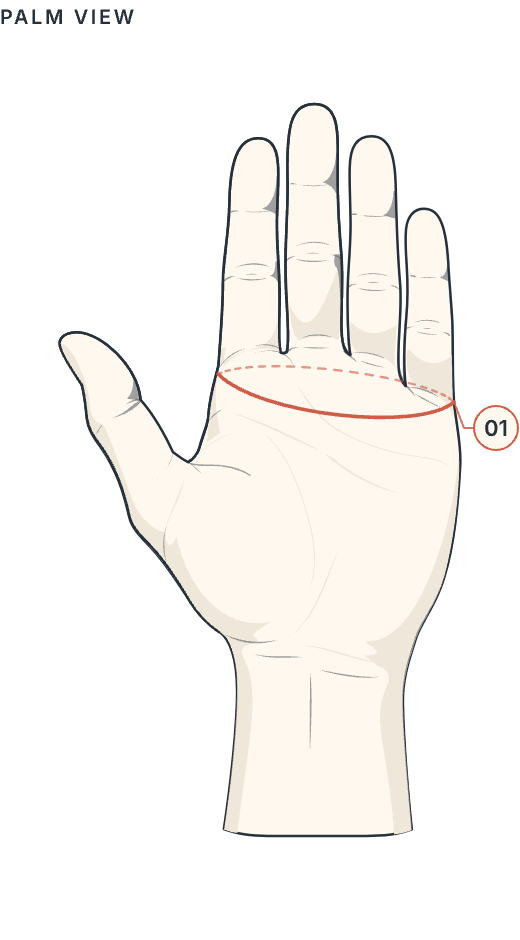
Plate 19
Hand girth
Palm view
01
Hand girth
With fingers together, measure the maximum circumference around the knuckles, excluding the thumb.
Maximum circumference around the knuckles, excluding the thumb; fingers together.
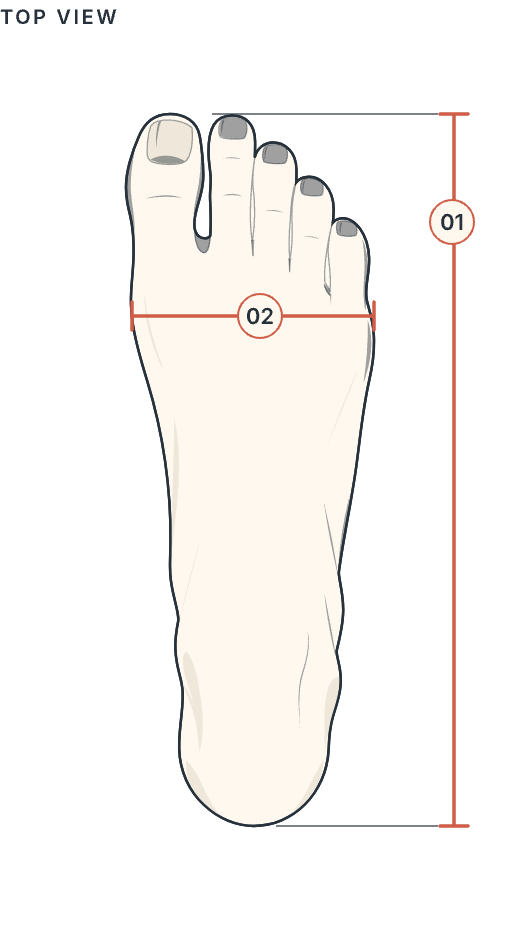
Plate 20
Foot length and width
Top view
01
Foot length
With the bare foot on a flat surface, measure straight from the back of the heel to the longest toe; use a stable, flat ruler.
02
Foot width
Standing barefoot, measure straight across the widest part of the foot; use a stable, flat ruler.
Barefoot: use a stable, flat ruler. Measure length with the foot on a flat surface and width while standing.
Plate 21
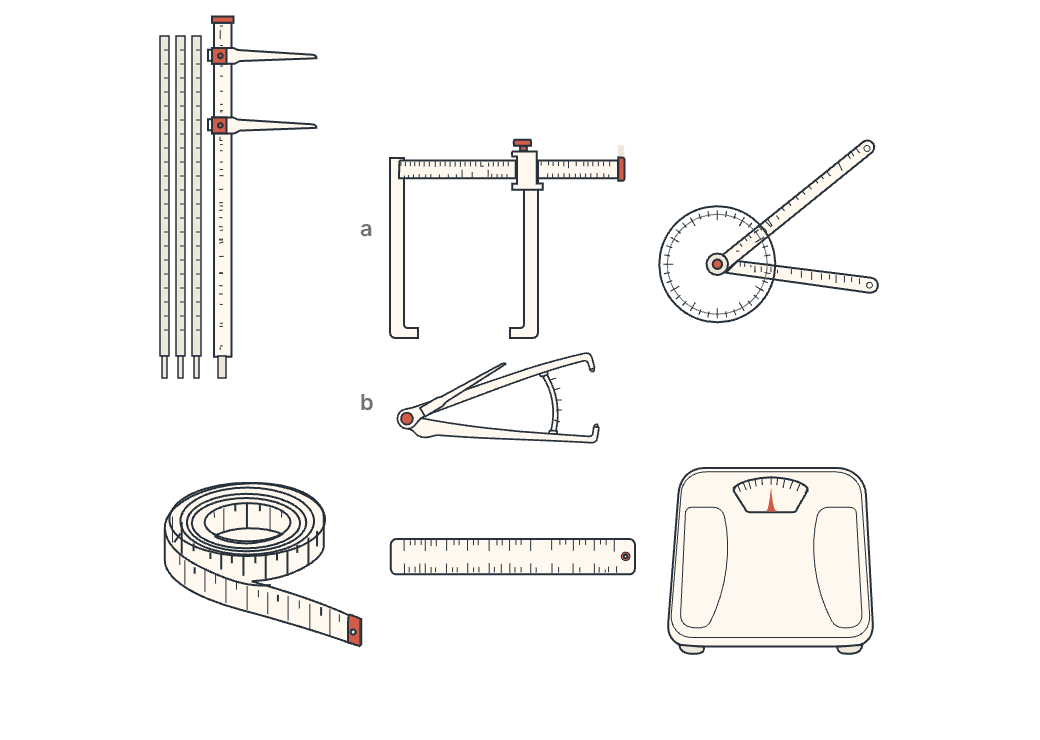
Measuring instruments
01
Anthropometer
Graduated rigid rod with movable arms; measures body width or length between selected points.
02
Calipers (a: small-bone; b: skinfold)
Adjustable jaws or arms measure diameters, thicknesses or distances.
03
Goniometer
Two pivoting arms and a degree scale measure the angle between body segments.
04
Tape measure
A marked flexible strip for taking body dimensions along or around the body.
05
Metal ruler
A marked straight edge for straight-line measurements.
06
Scale
An instrument for measuring body weight; use a calibrated scale.